Fabian Lenzen
About

I am a postdoctoral researcher at TU Berlin in the group Discrete Mathematics/
Selected projects
Dualities in Multiparameter persistence
A flat-injective presentation of a multiparameter persistence module \(M\) characterizes \(M\) as the image of a morphism from a flat to an injective persistence module. Like flat or injective presentations, flat-injective presentations can be easily represented by a single graded matrix, completely describe the persistence module up to isomorphism, and can be used as starting point to compute other invariants of it, such as the rank invariant, persistence images, and others. If all homology modules of a bounded chain complex \(F\) of flat \(n\)-parameter modules are finite dimensional,it is known that \(F\) and its shifted image \(\nu F[n]\) under the Nakayama functor are quasi-isomorphic, where \(\nu F[n]\) is a complex of injective modules. We give an explicit construction of a quasi-isomorphism \(\phi\colon F\to\nu F[n]\), based on the boundary morphisms of \(F\). If \(F\) is a flat resolution of a finite dimensional persistence module \(M\), then the degree-zero part \(ϕ_0\colon F_0 \to \nu F_n\) is a flat-injective resolution of \(M\). From our construction of \(\phi\), we obtain a method to compute a matrix representing ϕ0from the matrices representing the resolution \(F\). A Julia package implementing this method is available.
Lenzen, Fabian. 2026. “Computing Flat-Injective Presentations of Multigraded Persistence Modules.” To appear in: Homology, Homotopy and Applications. ArXiv: 2401.06008
2pac – Free resolutions in two-parameter persistent homology
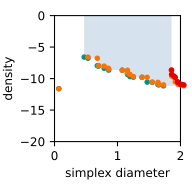
2pac is a software package that computes minimal free resolutions for two-parameter persistent homology. It uses a cohomological algorithm that, in certain aspects, is a two-parameter analog of Ripser, currently the fastest implementation of one-parameter persistent Vietoris–Rips homology. 2pac's algorithm relies on a multi-parameter generalization of the well-known duality between one-parameter persistent homology and cohomology. to the realm of multi-parameter persistence.
Ulrich Bauer, Fabian Lenzen, and Michael Lesnick. “Efficient Two-Parameter Persistence Computation via Cohomology”. In: 39th International Symposium on Computational Geometry (SoCG 2023). Leibniz International Proceedings in Informatics (LIPIcs), Volume 258, pp. 15:1-15:17, Schloss Dagstuhl – Leibniz-Zentrum für Informatik (2023). DOI: 10.4230/LIPIcs.SoCG.2023.15
Partial algebraic shifting
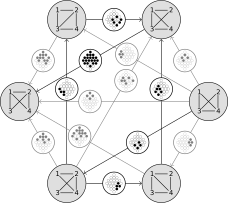
Algebraic shifting is a certain construction that assigns to a simplicial \(K\) complex a new complex \(\Delta(K)\) that shares several important properties (e.g., f-vector, Betti numbers, and others) with \(K\), but is combinatorially simpler, in the sense that it is homotopy equivalent to a wedge of spheres. In this project, we define a more fine-grained version \(\Delta_w(K)\) of algebraic shifting, called partial algebraic shifting, that is parametrized by elements \(w\) of the symmetric group \(S_n\) on the nunber \(n\) of vertices of \(K\). The set of all \(\Delta_w(K)\) for all \(w \in S_n\) defines a certain directed graph, which we call the partial shift graph of \(K\). We show that this graph is a directed acyclic graph.
Della Vecchia, Antony, Michael Joswig, and Fabian Lenzen. 2026. “An Empirically Fast Las Vegas Algorithm for Algebraic Shifting.” Journal of Symbolic Computation 137. DOI: 10.1016/j.jsc.2026.102582.
Antony Della Vecchia, Michael Joswig, and Fabian Lenzen, 2024. “Partial algebraic shifting”. arXiv: 2410.24044
A cell complex for the cyclooctane conformation space
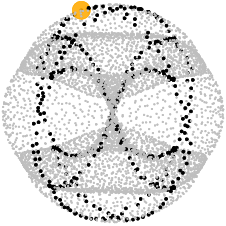

Cyclooctane is a cyclic molecule, consisting of eight carbon atoms, that are linked together to a 3-dimensional octagon (see figure). It admits a certain flexibility, which renders its conformation space, i.e., the set of all possible shapes the molecule can attain, a two-dimensional algebraic variety. We used persistent homology to infer a decomposition of the cyclooctane conformation space as a cell complex. Our results extend previous results by Shawn Martin as follows. We propose to stratify the conformation space based on certain symmetrics shared by some of the conformations (see figure). These allow for a more fine-grained analysis of the conformation space. Second, we analyze not only the structure of the conformation space itself, but also of its quotients under some of its symmetry groups. In particular, we propose a cell-complex representing the conformation space of a cyclooctane molecule with indistinguishable atoms, where as previous analyses assumed the atoms to be distinguishable or labeled.
Bauer, Ulrich, and Fabian Lenzen. 2026. “Inferring a Cell Structure on the Space of Cyclooctane Conformations.” In Proceedings of the MathSEE Symposium on Applications of Mathematical Sciences 2023, edited by Andreas Ott, Wolfgang Reichel, and John Warwicker. Springer Proceedings in Mathematics & Statistics 515. Springer. DOI: 10.1007/978-3-032-01279-1_14.
Publications
Journal articles and conference papers
Lenzen, Fabian. 2026. “Computing Flat-Injective Presentations of Multigraded Persistence Modules.” To appear in: Homology, Homotopy and Applications. ArXiv: 2401.06008
Della Vecchia, Antony, Michael Joswig, and Fabian Lenzen. 2026. “An Empirically Fast Las Vegas Algorithm for Algebraic Shifting.” Journal of Symbolic Computation 137. DOI: 10.1016/j.jsc.2026.102582.
Bauer, Ulrich, and Fabian Lenzen. 2026. “Inferring a Cell Structure on the Space of Cyclooctane Conformations.” In Proceedings of the MathSEE Symposium on Applications of Mathematical Sciences 2023, edited by Andreas Ott, Wolfgang Reichel, and John Warwicker. Springer Proceedings in Mathematics & Statistics 515. Springer. DOI: 10.1007/978-3-032-01279-1_14.
Ulrich Bauer, Fabian Lenzen, and Michael Lesnick. “Efficient Two-Parameter Persistence Computation via Cohomology”. In: 39th International Symposium on Computational Geometry (SoCG 2023). Leibniz International Proceedings in Informatics (LIPIcs), Volume 258, pp. 15:1-15:17, Schloss Dagstuhl – Leibniz-Zentrum für Informatik (2023). DOI: 10.4230/LIPIcs.SoCG.2023.15
Fabian Lenzen, 2023. “Clifford-symmetric polynomials”. Communications in Algebra 51, 3981–4011. DOI: 10.1080/00927872.2023.2196336
Fabian Lenzen, 2021. “Shuffling functors and spherical twists on \(D^\mathrm{b}(\mathcal{O}_0)\)”. Journal of Algebra 579, 26–63. DOI: 10.1016/j.jalgebra.2021.02.024
Preprints
Antony Della Vecchia, Michael Joswig, and Fabian Lenzen, 2024. “Partial algebraic shifting”. arXiv: 2410.24044
Fabian Lenzen, 2024. “Computing Fringe Presentations of Multigraded Persistence Modules”. arXiv: 2401.06008
Software
Fabian Lenzen, 2023. “2pac”. A C++ software package for two-parameter persistent cohomology. Available on Gitlab
Other and toy projects
TUB Beamer theme
A theme for \(\sf\LaTeX\) beamer that tries to follow the corporate design guidelines of TU Berlin. See my GitHub repository.
Other \(\sf\LaTeX\) packages
I am enthusiastic about fiddling around with \(\sf\LaTeX\) and TikZ. I have written a few smaller packages to faciliatete my life when it comes to
- printing individualized exam sheets, including controlled randomization of the questions
- printing my cv with a self-build class file, including biblatex-generated list of publications
- typesetting and referencing enumerated sub-theorems nicely, using amsthm and cleveref
- customizing biblatex, beamer and other packages I use a lot
For a full overview, please see my Gitlab repository.
Visualizations of simplicial complexes
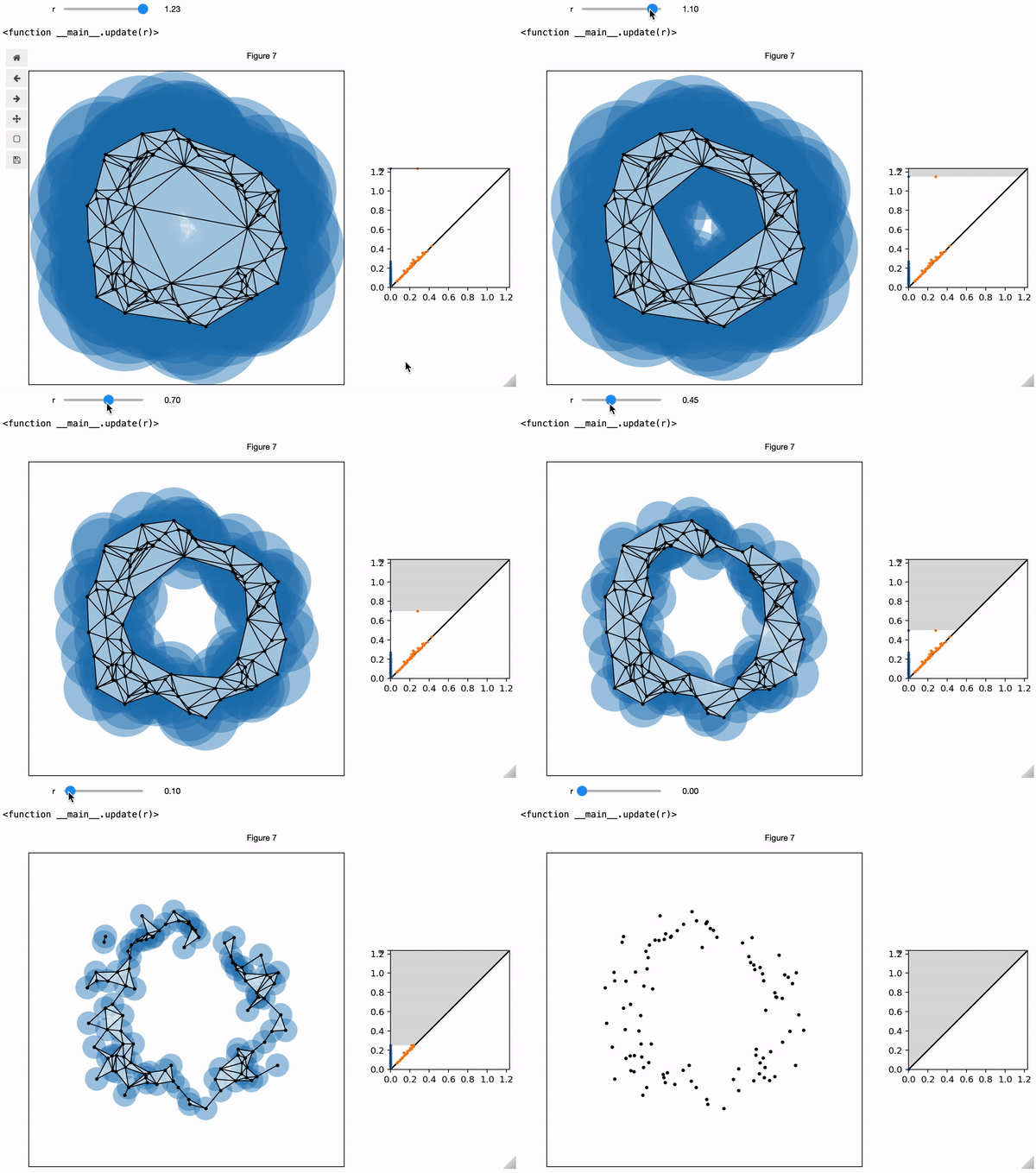
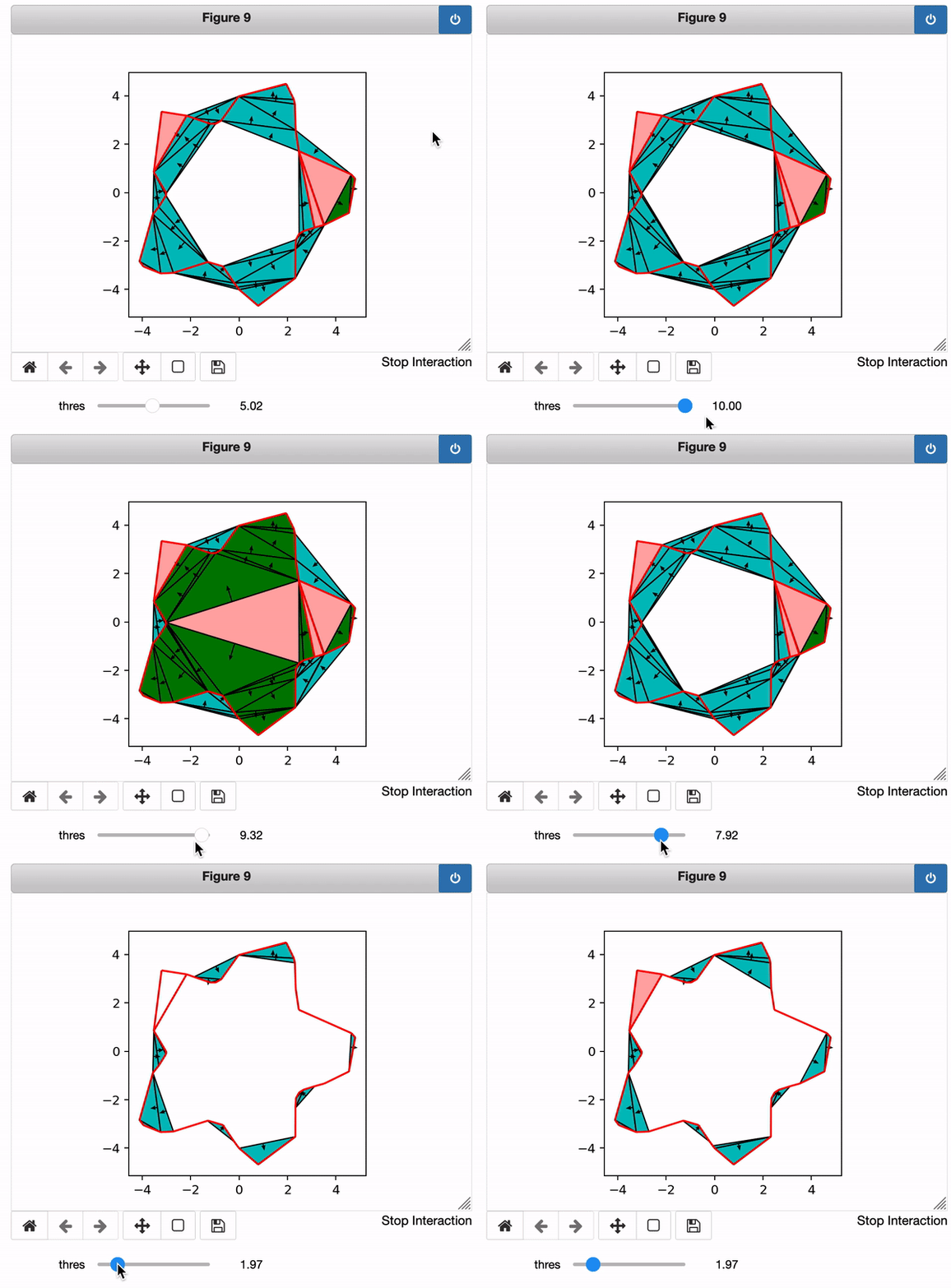
For preparing pictures for theses, talks, papers etc., and for use in teaching, I have created two Jupyter notebooks for the interactive generation and modification of common simplicial complexes.
The first notebook allows for the creation of alpha-, Čech- and Vietoris–Rips complexes from point cloud data at interactively chosen filtration levels, and the computation of their persistence diagrams.
The second notebook is devoted to the visualization of wrap complexes, a certain filtered simplicial complex that nicely captures the shape of the given point cloud, even if this shape is non-convex. The wrap complex obtained from the alpha-complex through the collapse along a discrete gradient vector field.